
Road User Charges
Abnormal Load Fees
Overview
An abnormal load refers to an indivisible object that cannot be transported without exceeding the legal mass or dimensional limits prescribed in the Road Traffic and Transport Act, 1999 (Act No. 22 of 1999).
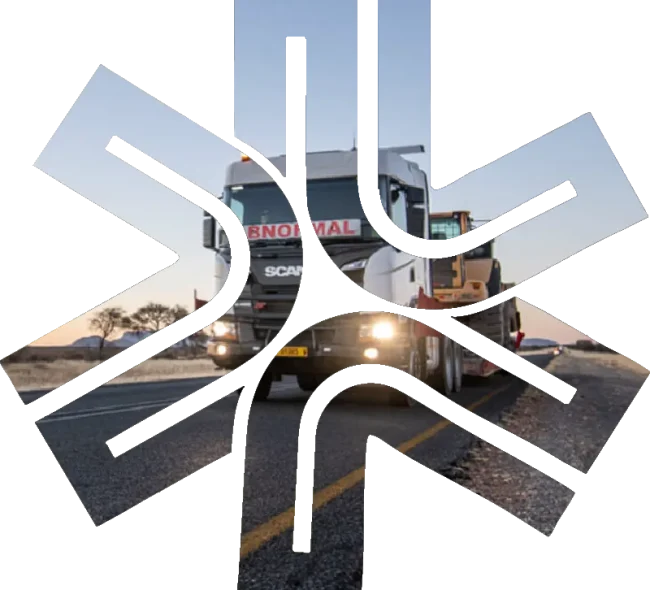
Vehicles transporting such loads are classified as abnormal vehicles because their dimensions or mass exceed the standard limits allowed on public roads.
Due to the potential impact of abnormal vehicles on road infrastructure and traffic flow, operators must obtain permits and pay Abnormal Load Fees before undertaking such trips.
Why Abnormal Load Fees Are Charged
Abnormal Load Fees are based on the user-pay principle, which requires road users to compensate for the additional impact their vehicles impose on the road infrastructure.
These fees help to:
- Compensate for the increased wear and structural stress on roads and bridges.
- Manage the safe movement of oversized or overweight loads.
- Reduce disruptions to normal traffic flow.
- Contribute to the maintenance and preservation of Namibia’s road infrastructure.
Revenue collected forms part of the Road User Charging System and supports the broader funding of road sector activities.
Legal Framework
The charging of Abnormal Load Fees is authorised by:
- The Road Traffic and Transport Act, 1999 (Act No. 22 of 1999)
- The Road Traffic and Transport Regulations, 2001
These laws regulate vehicle dimensions, mass limits, and compliance requirements for vehicles operating on Namibia’s road network.
Abnormal Load Fees are calculated based on technical engineering assessments that consider factors such as:
- Axle loading
- Tyre pressure
- Wheel spacing
- Total vehicle mass
- Load configuration
A specialised computerised system applies recognised engineering and transport-economic principles to determine the damage factor caused by the abnormal vehicle.
A permit officer performs the calculations with the support of a professional engineer.
Before transporting an abnormal load, operators must obtain an Abnormal Load Permit.
Permits are issued after the application has been reviewed and approved by the responsible authorities.
The associated fees must be paid through the Roads Authority’s NaTIS division before the trip can commence.
Four types of abnormal load permits may be issued depending on the nature of the vehicle and the load:
- Trip Permit – Issued for a single trip and valid for a specified number of days depending on the travel distance.
- Week Permit – Issued for minor abnormalities requiring short-term operations.
- Month Permit – Issued for vehicles with minor abnormalities operating over a longer period.
- Year Permit – Issued for recurring operations involving minor abnormalities, subject to specific conditions.
Permit holders must comply with various operational conditions, which may include:
- Observing route restrictions and bridge clearance requirements.
- Displaying appropriate warning signs and markings.
- Travelling outside peak traffic hours in certain areas.
- Using escort vehicles where required.
- Ensuring that loads do not exceed the approved dimensions or mass.
In some cases, police escorts may be required, particularly for large or complex loads.
Compliance with abnormal load permit conditions is monitored by:
- Roads Authority Transport Inspectors
- Weighbridge personnel
- Namibian Police
These officials may verify:
- Permit validity
- Vehicle dimensions
- Load configuration
- Compliance with approved routes and conditions
Failure to comply with permit conditions may result in fines, prosecution, or suspension of transport operations.
Supporting the Road Network
Abnormal Load Fees form part of Namibia’s broader Road User Charging System, ensuring that operators of oversized or overweight vehicles contribute fairly toward the maintenance and protection of the road network.
This system helps balance infrastructure preservation with industry and economic development needs.